How Often Should My HVAC System Be Serviced?
Quick Answer: HVAC Service Schedule
- Air conditioner or heat pump cooling: once per year, ideally in spring before cooling season
- Furnace or heat pump heating: once per year, ideally in fall before heating season
- Combined heating and cooling system: twice per year total
- Filters: check monthly, replace every 1 to 3 months depending on filter type and household
- Manufacturer warranties typically require annual professional maintenance to remain valid
The standard recommendation is twice a year: a cooling system tune-up in spring before the air conditioning season, and a heating system tune-up in fall before the heating season. This schedule applies to most central HVAC systems — split systems with a furnace and air conditioner, heat pumps, and packaged units. Some equipment can go a full year between service visits, but twice-yearly service is the standard that most manufacturers require to maintain warranty coverage and that most HVAC contractors recommend based on real-world failure patterns.
Schedule Before the Season Rush
The busiest times for HVAC contractors are the first heat wave of summer and the first cold snap of fall — exactly when systems are most likely to fail and when scheduling is hardest. Book your spring AC tune-up in March or early April, and your fall furnace tune-up in September or early October, before the seasonal rush. You will get better scheduling flexibility and your system will be ready before it is needed.
1. The Twice-Yearly Standard and Why It Exists
Heating and cooling systems are seasonal equipment. Your air conditioner sits idle all winter, and your furnace sits idle all summer. Before each season of heavy use, a professional tune-up catches problems that developed during the off-season — refrigerant leaks that occurred slowly over winter, a heat exchanger crack that formed during the last heating season, a capacitor that is weakening and will fail on the first hot day of summer. Catching these issues before the season starts means a planned repair on your schedule, not an emergency breakdown on the hottest or coldest day of the year.
The twice-yearly schedule also reflects the different maintenance needs of the cooling and heating sides of the system. An AC tune-up focuses on refrigerant charge, coil condition, condensate drainage, and electrical components. A furnace tune-up focuses on heat exchanger integrity, burner operation, flue venting, and safety controls. These are different tasks requiring different checks, which is why combining them into a single annual visit often means one side gets less thorough attention.
2. What a Professional AC Tune-Up Includes
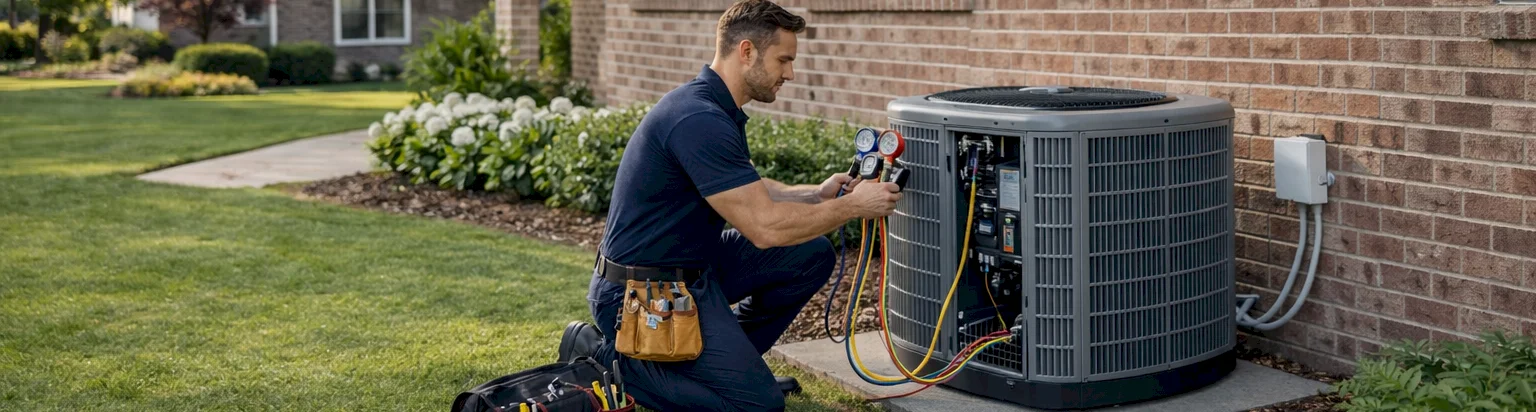
A thorough air conditioning tune-up covers the full system from the thermostat to the outdoor unit. The technician checks refrigerant charge and inspects for leaks, cleans the evaporator and condenser coils, inspects and cleans the condensate drain and pan, checks all electrical connections and tightens any that are loose, tests capacitors and contactors, measures airflow across the evaporator coil, lubricates moving parts, checks the blower motor and belt (if applicable), and verifies that the system is cycling on and off correctly.
The coil cleaning step is particularly important. Dirty evaporator and condenser coils reduce heat transfer efficiency, which forces the system to run longer to achieve the same cooling. A condenser coil that is 30% blocked with dirt and debris can reduce system efficiency by 20% or more. Regular cleaning keeps the system operating at its rated efficiency and reduces the load on the compressor — the most expensive component to replace.
3. What a Professional Furnace Tune-Up Includes
A furnace tune-up covers safety and performance. The technician inspects the heat exchanger for cracks or corrosion (a cracked heat exchanger can allow combustion gases including carbon monoxide to enter the living space), checks the burners and cleans them if needed, tests ignition and flame sensor operation, inspects the flue and venting for blockages or deterioration, checks the blower motor and belt, measures temperature rise across the heat exchanger, tests all safety controls and limit switches, and verifies that the system is venting properly.
The heat exchanger inspection is the most critical safety check in a furnace tune-up. Heat exchangers develop cracks from thermal stress over years of heating and cooling cycles. A crack is not always visible to the naked eye — technicians use combustion analyzers and sometimes camera inspection to detect cracks that would otherwise go unnoticed until they cause a CO problem. This is not a check that can be performed without professional equipment.
4. What Happens When You Skip Service
Skipping annual maintenance does not mean the system will fail immediately — but it does increase the probability of failure and the cost when failure occurs. Dirty coils reduce efficiency and increase operating costs. A failing capacitor that would have been caught and replaced for $150 during a tune-up becomes a system-down emergency call with after-hours rates. A refrigerant leak that would have been found and repaired early becomes a compressor failure after the system runs low on refrigerant for a full season.
Equipment that is not maintained also tends to fail at the worst possible times — during the first heat wave of summer or the first cold snap of winter, when HVAC contractors are at their busiest and scheduling is most difficult. Homeowners who maintain their systems on schedule get priority scheduling with their contractor and avoid the emergency service premium. Over a 15-year equipment life, the cost of skipping maintenance almost always exceeds the cost of the tune-ups that were avoided.
5. Filters: The Maintenance Task You Do Yourself
Filter replacement is the one maintenance task every homeowner can and should do between professional service visits. A clogged filter restricts airflow, which reduces system efficiency, increases operating costs, and can cause the evaporator coil to freeze in cooling mode or the heat exchanger to overheat in heating mode. Either condition stresses the equipment and can cause premature failure.
Standard 1-inch fiberglass filters should be checked monthly and replaced every 1 to 3 months. Thicker media filters (4 to 5 inches) last 6 to 12 months but should still be checked periodically. Homes with pets, multiple occupants, or occupants with allergies will need more frequent filter changes than the manufacturer's stated interval. When in doubt, check the filter — if it is visibly gray or clogged, replace it regardless of how long it has been in service.
6. Maintenance Club Memberships: Are They Worth It?
Many HVAC contractors offer maintenance club or service agreement programs that bundle twice-yearly tune-ups with additional benefits such as priority scheduling, discounts on repairs, and waived diagnostic fees. For homeowners who want to stay on a consistent maintenance schedule without having to remember to call each season, these programs offer real value.
The math typically works in the homeowner's favor. Two tune-ups per year at standard rates might cost $150 to $250 each, or $300 to $500 per year. A maintenance club membership covering the same two visits often costs $150 to $250 per year, with the added benefits of priority scheduling and repair discounts. If you have a repair in a given year, the discount alone often more than covers the membership cost. The main requirement is choosing a contractor you trust to do the work properly — a maintenance agreement with a contractor who rushes through visits provides less value than paying full price with a contractor who is thorough.
Still Have Questions? We Can Help.
ProComfort offers maintenance club memberships for Indianapolis homeowners that include two tune-ups per year, priority scheduling, and repair discounts. Ask about our current membership rates when you call.