Why Is My Furnace Not Turning On?
Quick Answer: Common Reasons a Furnace Won't Turn On
- Thermostat set to COOL or FAN instead of HEAT — check the mode setting first
- Thermostat set point below current room temperature — raise it 5 degrees above room temp
- Dead thermostat batteries — replace them and try again
- Tripped circuit breaker on the furnace circuit — reset it once
- Furnace power switch turned off — check the wall switch near the unit
- Clogged air filter causing the furnace to shut down on high-limit — replace the filter
- Failed ignitor, flame sensor, or control board — requires a technician
A furnace that will not turn on is one of the more stressful home problems, especially when temperatures are dropping. The cause can be as simple as a tripped circuit breaker or a thermostat set to the wrong mode — both of which you can check yourself in a few minutes. It can also be a failed ignitor, a faulty control board, a tripped limit switch, or a gas supply issue — all of which require a professional. This page walks through the most common causes in order from simplest to most involved, so you know what to check before calling and what to tell the technician when you do.
If You Smell Gas, Leave the House
If you smell natural gas near the furnace or anywhere in the home, do not attempt to diagnose or restart the furnace. Leave the house immediately, leave the door open, do not operate any light switches or electrical devices, and call your gas utility's emergency line from outside. Do not re-enter until the utility company has cleared the home.
1. Start With the Thermostat
Before assuming there is a mechanical problem, check the thermostat. Confirm it is set to HEAT mode, not COOL or FAN ONLY. Confirm the set point is at least 3 to 5 degrees above the current room temperature — if the room is 68°F and the thermostat is set to 68°F, the furnace has no reason to run. If your thermostat uses batteries, replace them even if the display looks normal; a low battery can cause erratic behavior without a visible warning.
If you have a programmable or smart thermostat, check whether a schedule is overriding your manual setting. Some thermostats will revert to a programmed temperature after a period of time, which can make it seem like the furnace is ignoring your input. Temporarily switching to manual hold mode will confirm whether the schedule is the issue.
2. Check the Circuit Breaker and Power Switch
Furnaces have a dedicated circuit breaker in your electrical panel. If it has tripped, the furnace will not receive power and will not attempt to start. Find the breaker labeled for the furnace or air handler, confirm it is in the ON position, and reset it if it has tripped to the middle position. If the breaker trips again immediately after resetting, stop — a breaker that trips repeatedly indicates an electrical fault that needs professional attention.
There is also a power switch on or near the furnace itself, which looks like a standard light switch and is sometimes mounted on the wall nearby. It is easy to accidentally switch this off, especially in utility rooms where it might be bumped. Confirm it is in the ON position. Some furnaces also have a door safety switch — if the furnace access panel is not fully seated, the switch prevents the unit from running as a safety measure.
3. Check the Air Filter
A severely clogged air filter restricts airflow to the point where the furnace overheats. When that happens, a safety device called the high-limit switch shuts the furnace down to prevent damage. The furnace may attempt to restart, overheat again, and shut down again in a cycle — or it may lock out entirely and refuse to start until the condition is resolved.
Pull the filter and inspect it. If it is visibly gray, clogged, or has not been replaced in several months, replace it with a fresh filter and try restarting the furnace. If the furnace starts normally after the filter change, the high-limit switch did its job. If the furnace still will not start after replacing the filter, the high-limit switch may have tripped and needs to be reset by a technician, or there may be a separate issue.
4. Check for a Pilot Light or Ignition Error
Modern furnaces use an electronic ignition system rather than a standing pilot light. When the thermostat calls for heat, the control board signals the ignitor to heat up, the gas valve opens, and the burners light. If any step in this sequence fails, the furnace will not produce heat. Most modern furnaces will attempt ignition two or three times before locking out and displaying an error code.
If your furnace has a digital display or a blinking LED light on the control board, the error code it shows will point to the specific failure — ignitor, flame sensor, pressure switch, or gas valve. A technician can read this code and diagnose the problem quickly. Do not attempt to inspect or replace ignitors, flame sensors, or gas valves yourself. These components involve gas and high-voltage electricity, and incorrect handling creates serious safety risks.
5. Gas Supply Issues
If the furnace is attempting to ignite but no flame appears, the gas supply may be interrupted. Check that the gas shutoff valve on the supply line to the furnace is in the open position — the valve handle should be parallel to the pipe, not perpendicular. If other gas appliances in the home (water heater, stove) are also not working, the issue may be with the main gas supply, and you should contact your gas utility company.
If the gas shutoff is open and other appliances are working normally, the issue is likely the furnace's gas valve or a pressure switch that is preventing the valve from opening. Both require a technician to diagnose and repair. Never attempt to bypass or manually operate a gas valve.
6. When to Call a Technician
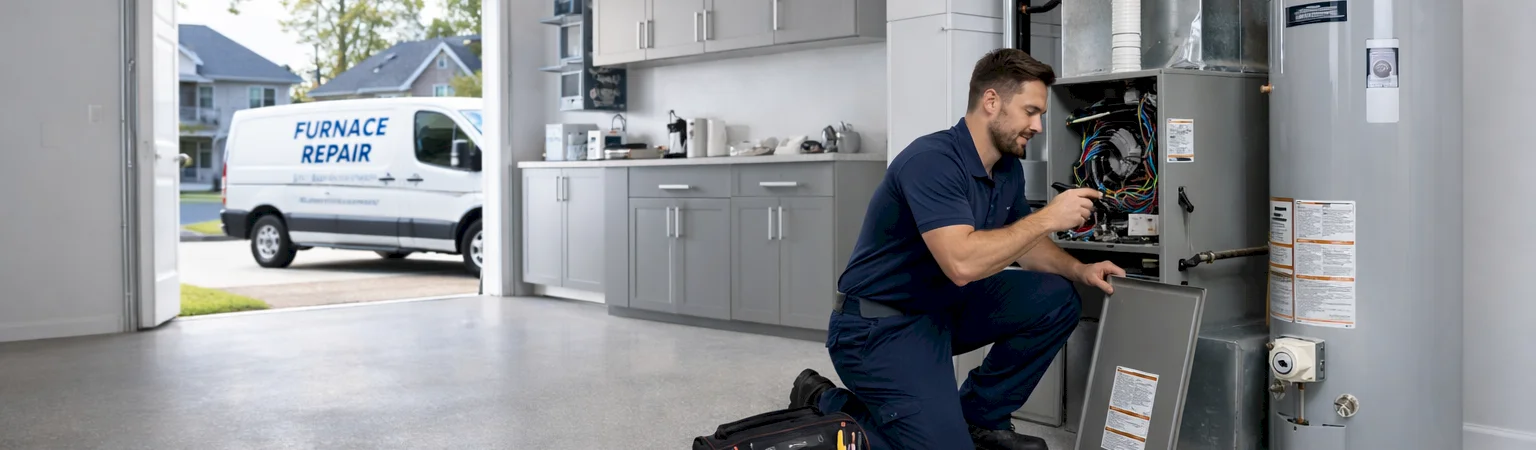
If you have checked the thermostat, circuit breaker, power switch, and air filter and the furnace still will not start, the problem is inside the unit and requires professional diagnosis. Common causes at this stage include a failed hot surface ignitor (a fragile ceramic element that heats to 1,800°F to light the burners), a dirty or failed flame sensor, a faulty pressure switch, a cracked inducer housing, or a failed control board.
In Indianapolis, furnace failures during cold weather are treated as priority calls by most HVAC contractors. When you call, tell the technician what you have already checked and whether the furnace is displaying any error codes. This saves diagnostic time and helps them arrive with the right parts. If the furnace is more than 15 years old and the repair cost is significant, ask the technician to walk you through the repair-versus-replace math before authorizing work.
Still Have Questions? We Can Help.
If your furnace will not turn on and the basic checks have not resolved it, our technicians in Indianapolis are available for same-day and emergency service. Call us and we will diagnose the problem and give you a clear repair estimate before any work begins.